The Birkin Bag of Cars. You've Probably Never Heard of It.
Born as a military reject, adored by Bardot and Bond, and now the most quietly radical vehicle in luxury hospitality. Here's why nothing else comes close.
The Reject That Became an Icon
In 1959, a team of British engineers presented the military with a vehicle so stripped-down, so absurdly minimal, that it could be dropped from an airplane. The British Army took one look at it and said no. Too low. Too light. Too strange. It couldn’t even make it through mud.
That car was the Moke. And its rejection might be the greatest thing that ever happened to luxury hospitality.
Because the vehicle that wasn’t tough enough for the battlefield turned out to be perfect for the beach. For the cobblestone lanes of Saint-Tropez. For the valet circle of a resort where the room rate starts with a comma. What the military dismissed as inadequate, Brigitte Bardot drove barefoot through the South of France. Paul McCartney kept one on his estate. James Bond commandeered a fleet of them across four films. The Beach Boys practically used one as a band member.
The Moke was never designed to be a luxury object. It just became one—the way all truly iconic things do—by being so unapologetically itself that the world bent around it.
The Birkin Problem
There’s a useful comparison in the fashion world, and it’s one worth making carefully. When Hermès prices a Birkin bag in the tens of thousands, nobody writes a think piece about whether it’s “worth it.” The bag has transcended the question. It represents French craft, controlled scarcity, and the kind of quiet authority that doesn’t need to announce itself. You either understand or you don’t.
The Moke operates on the same frequency. Only hundreds are produced each year—globally. For context, Porsche builds about 300,000 vehicles annually and is considered exclusive. Tesla ships nearly two million. The Moke exists in a production class so small it barely registers as an automaker. It’s more atelier than assembly line.
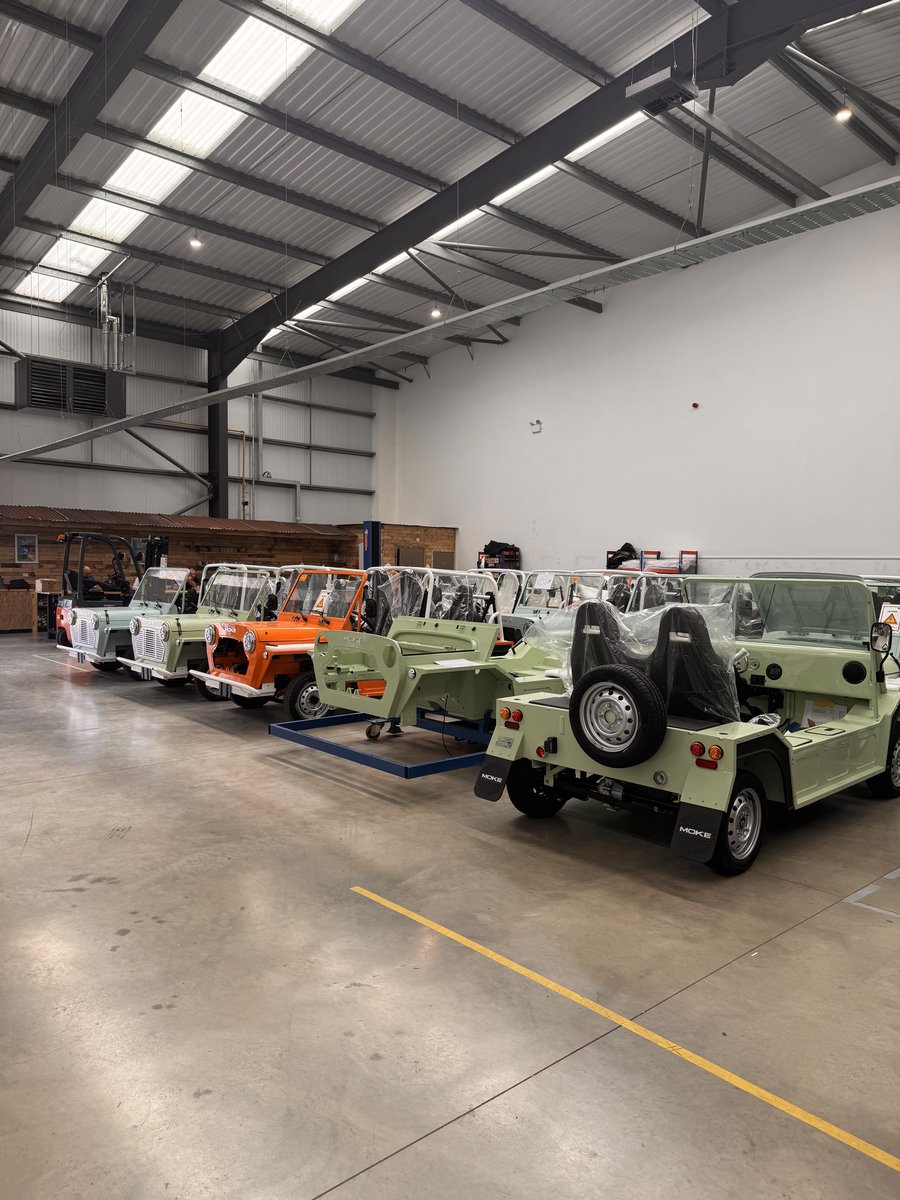 Controlled production: Each Moke is hand-fitted and individually tested, not mass-manufactured.
And like the Birkin, the Moke’s value isn’t really about what it’s made of. It’s about what it represents. Six decades of design heritage. A silhouette so perfect it hasn’t needed a redesign since 1964—the same year the Beatles played Ed Sullivan and Cassius Clay became Muhammad Ali. Good years for icons.
The vehicle is hand-assembled at Moke International’s factory in Leamington Spa, Warwickshire—the heart of Britain’s automotive corridor—by engineers who work on it the way a watchmaker works on a movement: individually, deliberately, with the kind of attention that simply cannot be automated. Every panel is fitted by hand. Every electrical system is tested on its own. This is not how you build a car if you’re trying to maximize shareholder returns. This is how you build a car if you’re trying to build something that lasts.
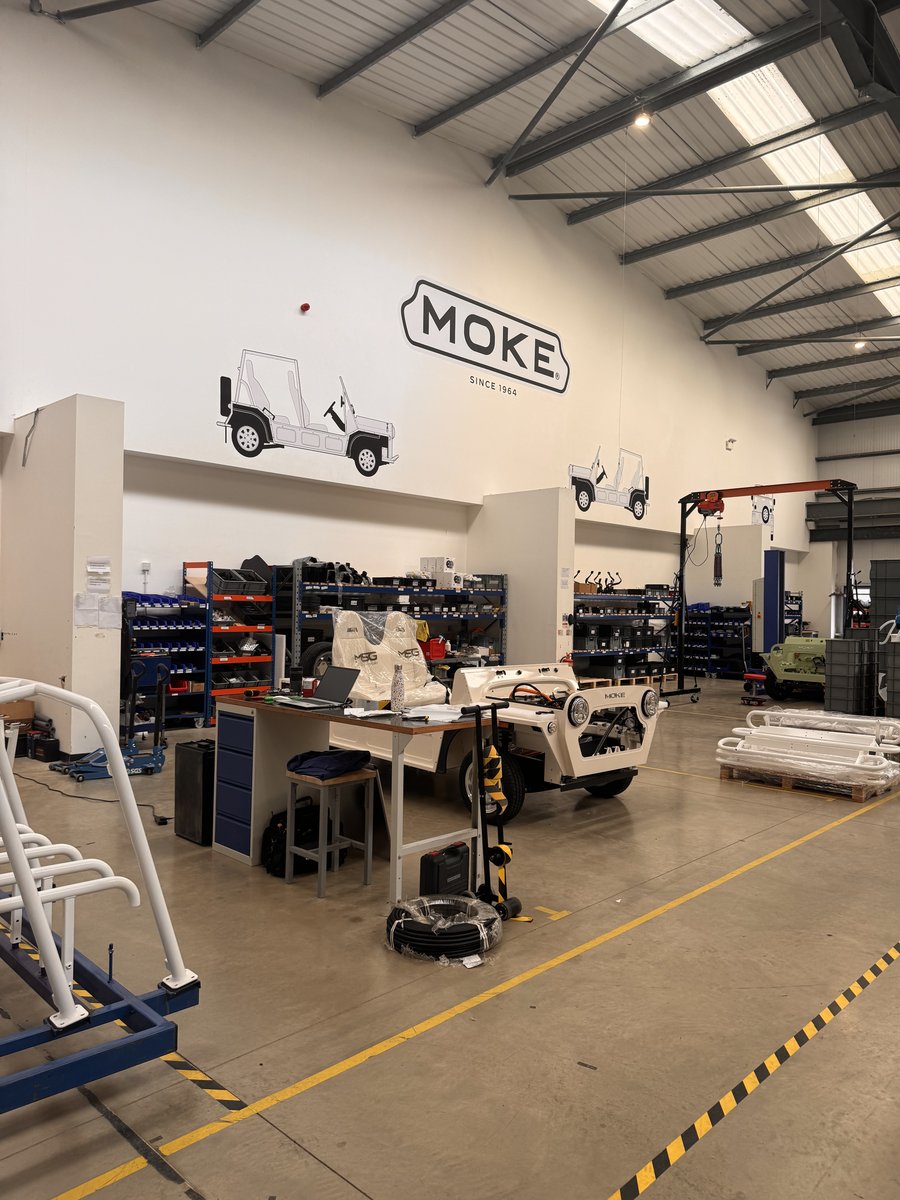 Moke International’s Leamington Spa facility: where hand-assembled craftsmanship meets British engineering heritage.
Why There Are Fakes (and Why That’s the Point)
Here’s where it gets interesting. The Moke has a counterfeiting problem.
Chinese manufacturers have, in recent years, flooded the market with vehicles that bear a passing resemblance to the Moke. They’re cheap. They’re available. And from across a parking lot, on a cloudy day, through squinted eyes, you might confuse one for the real thing—in the same way you might confuse a Canal Street handbag for a Birkin if you’ve never held the genuine article.
Up close, the illusion collapses. These are low-speed vehicles with golf-cart bones dressed in automotive clothing. They skip the crash testing, sidestep the safety certifications, and cut every engineering corner that the authentic Moke painstakingly reinforces. A real Moke meets UK and EU road safety standards. It has rollover protection, proper braking systems, and a fully engineered electric powertrain with sophisticated battery management. The imitators have none of this—which matters enormously when the vehicle is carrying your guests along a coastal highway at a resort that carries your name.
But the existence of knockoffs isn’t actually the problem. It’s the proof. Nobody counterfeits something that isn’t desirable. Nobody builds a cheap imitation of a vehicle that doesn’t command the room. The fakes are an involuntary tribute—the sincerest form of flattery from manufacturers who understand the Moke’s appeal even as they fail to replicate it.
The difference reveals itself over time, as these things always do. In reliability under daily use. In resale value. In the insurance claims that never happen because the vehicle was built properly in the first place. And—most critically for anyone in the hospitality business—in the look on a guest’s face when they realize the car waiting for them at the hotel isn’t a novelty. It’s an icon.
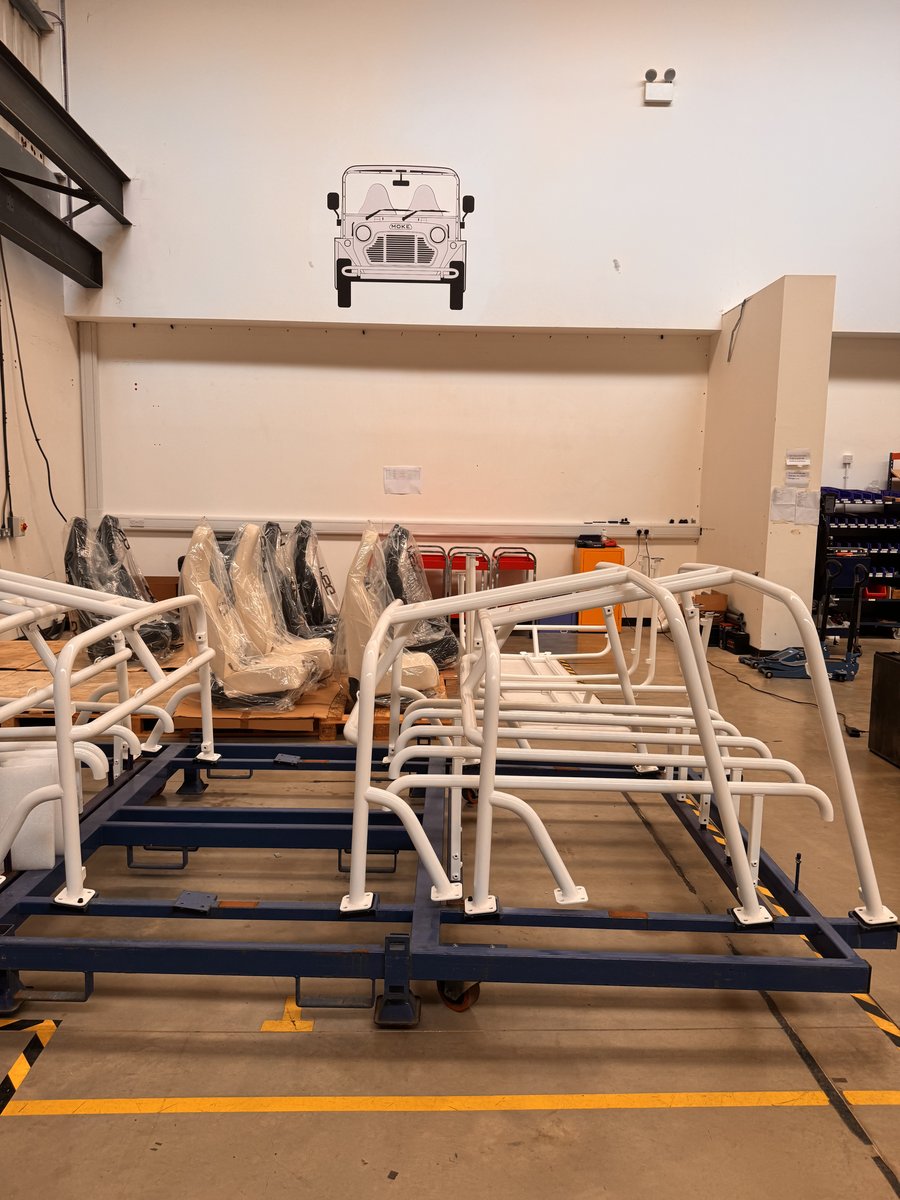 Hand-fitted frames and individually tested components: This is the engineering standard that counterfeits cannot match.
What Hospitality Gets Wrong About Guest Transportation
Most luxury properties treat guest transportation as a logistics problem. Something to be solved with shuttles, golf carts, or the occasional Tesla for the eco-conscious marketing angle. The vehicle is an afterthought—a means of getting from the lobby to the beach club without anyone complaining.
This fundamentally misreads how luxury guests experience a property.
Every touchpoint is the brand. The thread count. The scent in the lobby. The weight of the room key in your hand. And the vehicle that greets you when you want to explore is no different. A generic shuttle says: we’ll get you there. An authentic Moke says: you’re somewhere extraordinary, and even the ride is part of the story.
There’s a reason the Moke has been a fixture at the world’s most storied coastal properties for decades—from Caribbean estates to Mediterranean villas to the kind of Hawaiian resorts where discretion is part of the rate. The vehicle isn’t a transportation solution. It’s an experience engine. Guests photograph it. They post it. They remember it years later, long after they’ve forgotten the restaurant or the spa treatment. The Moke becomes the memory.
And from an operations standpoint, the numbers are equally compelling. An authentic Moke is engineered for the kind of daily, heavy-rotation use that hospitality demands. It runs reliably for years, not months. It holds meaningful resale value at the end of its service life—a genuine asset on the balance sheet, not a depreciating liability. The knockoffs? They tend to develop electrical issues within the first season. By year two, they’re furniture.
Learn more about integrating luxury Moke fleet solutions into your property’s guest experience strategy.
The Quiet Radicalism of Doing Less
What makes the Moke genuinely subversive in 2026 is its refusal to be more. In an era when every vehicle is a rolling technology platform—screens, sensors, autonomous features, over-the-air updates—the Moke is elementally simple. No doors. No roof. No pretense. It’s a steel frame, an electric motor, four wheels, and the open sky.
This is not a limitation. This is a design philosophy.
The original 1964 Moke was so basic that the passenger seat was optional. You could literally pick the car up and carry it. What looked like poverty of design turned out to be purity of purpose—and that purity is exactly what makes the Moke feel so right at a five-star property. It doesn’t compete with the experience. It enhances it. The wind in your hair, the sun on your skin, the unhurried pace of a vehicle that was never meant to rush anywhere—this is what guests are paying for when they book a luxury stay. Not more technology. More feeling.
The modern electric Moke preserves this ethos perfectly. The powertrain is whisper-quiet. The range is calibrated for resort-scale exploration, not cross-country ambition. There’s a drive mode—indicated by a small illuminated palm tree on the dash—that limits torque for beach driving. An illuminated palm tree. If that doesn’t tell you everything about what this vehicle understands about its own purpose, nothing will.
Why This Matters Now
The hospitality industry is in the middle of an identity correction. After years of chasing scale and standardization, the most successful luxury properties are returning to what actually differentiates them: specificity, authenticity, and the kind of details that can’t be replicated by a brand playbook.
The Moke is that detail made drivable.
Ohana Mobility partners with luxury properties to deploy authentic Moke fleets as a premium guest amenity—fully managed, fully insured, and fully integrated into the guest experience. We do this because we’ve spent years in the mobility space and we know what works. And what works, without exception, is the real thing.
Not a lookalike. Not a compromise. The car that Bardot drove. The car that Bond drove. The car that was too cool to die—now electric, still iconic, and waiting in your valet circle.
Explore our white-label platform for managing guest mobility at scale across multiple properties.
Ready to transform your guest transportation? Let’s talk about what a Moke fleet looks like at your property.